Dressing Up For Work To Support Local SMEs

SME_1

Being in a nation like Brunei Darussalam where tradition plays an integral role in our society, it isn't surprising that many of us, especially the locals, have a deep attachment to things that our ancestors have always valued.

Walking among the beautifully woven fabric made of expensive gold, silver and the striking colours of the rainbow threads, one can easily get lost in the intricacy of the designs embedded within one of Brunei's heritage that has come to be endearingly known as Kain Tenunan.

SME_2 SME_3

SME_4

SME_5 SME_6

Created in the heart of 'Rumah Tenunan', the makings of the masterpiece that has become one of the many symbols of the Bruneian character for more than half a millennia is an art form in itself. And as laborious as it is, it is amazing that the end product looks as simple as it does.

As these types of fabrics continue to withstand the test of time, interestingly, many Small and Medium Enterprises (SMEs) in this trade have adapted with age and many of them have incorporated the Kain Tenunan into various products such as pencil cases, small bags, shoes and laptop carriers.

Explaining how complicated the process of making a standard two-metre piece can be, a Kain Tenunan maker told the Weekend Bulletin, "No matter how long you've been doing this for, be it 10 years or more, one is always bound to make mistakes."

Precision is obviously the key, as one misstep would mean having to go back and re-doing what needs to be fixed, she explained.

Ranging from as low as $200 to as high as $1,000, quality is assured for these spectacular fabric. Tourists from all over the world have been known to pay the highest of prices just so that they can have a piece of Brunei to take home with them, according to observers.

Though the Kain Tenunan is still used for traditional ceremonies such as weddings and royal ceremonies, not many among the younger generation are too familiar with this particular practice let alone the names of each design that can range from the more popular Kain Jongsarat to the Kain Tenunan Beragi Bertabur.

Luckily, however, one government initiative is looking to promote this unique craft.

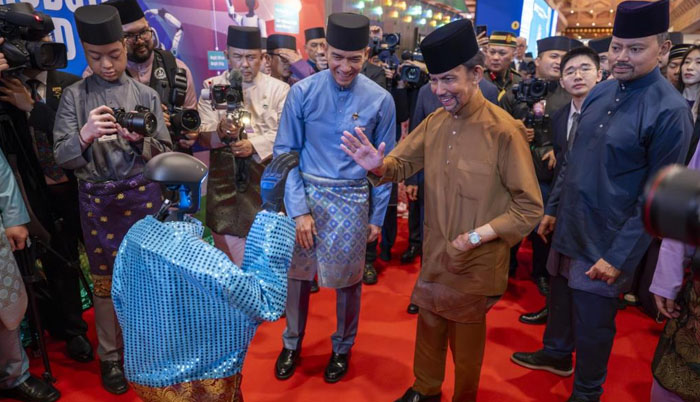
Once a week, every Thursday, primed and smart in their traditionally-cut wear with a tasteful twist, dozens of public servants at the Ministry of Industry and Primary Resources (MIPR) have been coming in to work looking exceptionally stunning like they are ready for a promotional photo shoot.

The enthusiasm for the programme to support local SMEs is definitely electric judging from the number of public servants wearing the Sinjang (for men) and Baju Kurong (for women).

In fact, some, if not all, of the officers openly said that they look forward to wearing their locally bought Tenunan.

"This is actually an encouragement for us, especially for the younger generation," expressed Hajah Siti Amin Mahali and Normah Haji Sharbini. The quality is better than those that are machine-made mostly because the fabric is smoother, they added.

Other officers, too, have said that the initiative has widened their horizons on this industry. And ever since the movement took off, they are now more familiar with the names of the different forms of Tenunan and can now easily identify designs that are exclusively Bruneian.

Though considered pricey, many of the officers remain staunch in shouldering the commitment of wearing Tenunan to support local entrepreneurs specialising in this trade. Some have even made special orders to have their Tenunan personalised. So steadfast is the support for the cause that departments under the MIPR have expressed plans to have their department name and logo embroidered in Tenunan.

For the women, the wearing of the Kain Tenunan presents them with a bigger fashion opportunity to be more like the men in a sense that they now can wear their Tenunan skirts almost as often as the men wear their Sinjang seeing that women tend to mostly wear Kain Tenunan on their wedding day.

"We're now not just limited to the normal Baju Kurongs," they quipped.

Non-Malays, too, have been persuaded to hop on the bandwagon and have since caught the fashion fever.

Among the demographics at the ministry, both Marcus Tan Tee Peng, a local Chinese, and Dr Joselito F Santiago, a Filipino resident, looked dapper in their full-on Malay attire complete with their 'Made-in-Brunei' Songkok.

"This is my first complete set in the 20 years I've been here," shared Dr Santiago who wore a white-cream Tenunan Sinjang specially picked by his wife. He noted that his participation was to support the local industry and keep the culture alive.

"This is good for us to know seeing that we're Bruneians," said Marcus, adding that the move has also given him a profound meaning of what it means to be patriotic. And like his Malay friends, he also plans to customise his own Tenunan Sinjang.

At one point obscure from the general society, many of this form of cottage industries have set up shop at Sumbangsih Mulia in Beribi, thanks to governmental initiative aimed at providing makers a wider opportunity to showcase their products.

--Courtesy of Borneo Bulletin
blog comments powered by Disqus