Global Climate Talks On Track
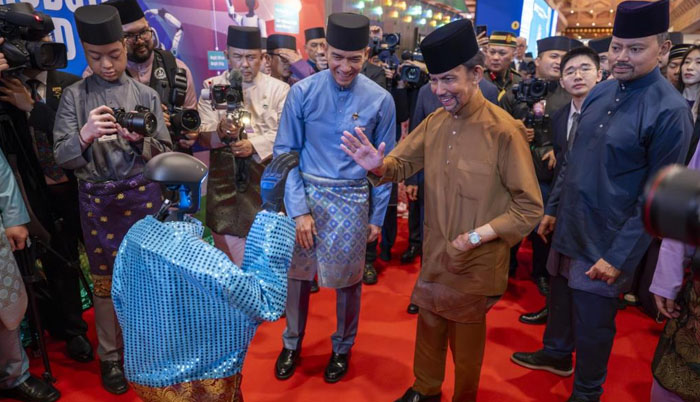
His Royal Highness the Crown Prince at the dinner hosted by Mr Patrick Manning, Prime Minister of the Republic of Trinidad and Tobago at Hyatt Regency Hotel.
Crown Prince On 2nd Day Of CHOGM
Bandar Seri Begawan - His Royal Highness Prince Haji Al-Muhtadee Billah, the Crown Prince and Senior Minister at the Prime Minister's office, attended the First Executive Session and Retreat Session on Saturday.
The meetings were chaired by Mr Patrick Manning, Prime Minister of the Republic of Trinidad and Tobago, is the Chair in Office of the Commonwealth Heads of Government Meeting (CHOGM).
HRH, who is a personal representative of His Majesty the Sultan and Yang Di-Pertuan of Brunei Darussalam for the Commonwealth Heads of Government Meeting, also joined Other leaders for a lunch hosted by Mr Patrick Manning, Prime Minister of Republic of Trinidad and Tobago, during which a Youth Dialogue was also held.
On Saturday evening, His Royal Highness joined other Commonwealth Leaders for a dinner hosted by Mr Manning at the Hyatt Regency Hotel, where guests were treated to a colourful cultural performance.
According to an AFP report, global climate talks to be held in Copenhagen got a big boost over the weekend when leaders representing a third of the planet's population put their full weight behind sealing a deal.
The heads of government of the 53-nation Commonwealth announced late Saturday that a legally binding climate accord was "essential" and they backed 'the December 7-18 Copenhagen negotiations called to draft a successor treaty to the Kyoto Protocol.
The Commonwealth Climate Change Declaration, issued mid-way through a three-day summit in Trinidad, also hailed moves promoted by Britain and France to establish a 10-billion-dollar fund to help offset the cost to poor countries that cut carbon output.
That financing offer, combined with greenhouse gas; emission cuts announced over the past two weeks by most of the world's biggest polluting nations, prompted leaders to swap skepticism for optimism.
"I remain fully convinced that it will be possible to reach an agreement in Copenhagen," Danish Prime Minister Lars Loekke Rasmussen, who will host the talks, said in Trinidad, where he was a special guest.
UN Secretary General Ban Kimono said he believed there was momentum for a deal. But he cautioned that it was not yet certain that a treaty would emerge from Copenhagen for signing in 2010.
"We are united in purpose, we are not yet united in action," he said, urging world leaders "to stay focused, stay committed and come to Copenhagen".
So far, 90 leaders have confirmed they will attend the talks in the Danish capital, including US President Barack Obama, lifting them to the status of an important international summit.
"We, as the Commonwealth, representing one third of the world's population, believe the time for action on climate change has come," Australian Prime Minister Rudd said as he unveiled the Commonwealth agreement.
"We believe the political goodwill and resolve exists to secure a comprehensive agreement at Copenhagen," he said China, the United States, the European Union and Brazil have all announced greenhouse gas emission reduction targets designed to contain the level of global warming.
India remains the only big polluter still to declare its target, though Prime Minister Manmohan Singh promised on Saturday it would be unveiled soon and would be "ambitious".
For-all the -political determination and talk of consensus expressed at the Commonwealth summit, several points of contention remain that could prove divisive in Copenhagen.
The Commonwealth declaration, for instance, revealed that differences remain over whether global temperature increases should be constrained to below 1.5 degrees Celsius (2.7 degrees Fahrenheit) or to no more than two degrees Celsius (3.6 degrees Fahrenheit).
Such a range could mean the difference between survival and catastrophe for low-lying island states such as Commonwealth members the Maldives, Vanuatu and Tuvalu - threatened by flooding from global warming.
Excessive action to rein in rising temperatures, though, could stunt economic growth not only in industrialised countries but also developing nations such as India.
The amount of money to be made available to poorer countries adopting environmental measures was also-a subject of debate.
Although the Copenhagen Launch Fund evoked in r the Commonwealth statement was hailed as a step forward, its 10 billion dollars a year was a fraction of the cash required to offset lost economic potential in many countries.-- Courtesy of Borneo Bulletin
| < Prev | Next > |
|---|
Hot Topics of the Day
-
Education Course: Australia Much Tougher Than In The UK The courses in Australia are much tougher compared to UK. My own experience,...
-
Don't Underestimate Australian Universities I want to comment about what a writer name ‘honored' commented on the honours...
-
Australia's Postgraduate Scholarship Pay You More (1)The average entry requirement in Australian universities is not lower than...
-
Please Allow Us To Celebrate Valentine! Just a couple more days come Valentine Day. It is a day where people and the...
-
You Have To Do Honours In Australia To Understand I don't agree with the fact that honours degree is the same as masters from UK....
-
Odd Claim From "Prof Canadian" I read with interest an article on Canada Universities by Prof Canadian and I...
-
Don't Fret Over Licence Test Issue I would like to comment on an article entitled Do We Need Stunt Rider Test To...